How to Automate Your Small Business Without Coding
Disclosure: We may earn a commission when you purchase through links on this site, at no extra cost to you. How we make money.
If you’ve ever spent 20 minutes manually copying a contact form submission into a spreadsheet, sent the same onboarding email for the fifteenth time, or followed up on an invoice you already followed up on twice — you already understand the problem automation solves. The good news is that you don’t need a developer, a technical co-founder, or a computer science degree to fix it. The no-code automation tools available today are genuinely designed for people who run businesses, not people who build software. This guide tells you exactly where to start, which tools to use, and how to build an automation system that runs your routine work while you focus on the parts of your business only you can do.
Why Most Small Business Owners Never Start Automating
The barrier isn’t technical — it’s mental. Most small business owners assume automation is something that happens after they hire a developer or reach a certain revenue milestone. Neither is true. The no-code movement has fundamentally changed what’s possible without writing a single line of code, and the tools have gotten simple enough that setting up your first workflow is genuinely comparable to building a spreadsheet.
The other barrier is not knowing where to start. “Automate my business” is too large a task to act on. “Automate the step where I manually create a ClickUp task every time someone fills out my contact form” is specific, achievable, and done in 15 minutes. This guide gives you the specific starting points.
Step 1: Identify What to Automate First
Before touching any tool, spend 10 minutes doing a quick audit of your week. Ask yourself: what tasks do I do repeatedly, in the same way, every time? These are your automation candidates. The best starting points share three characteristics:
- They happen frequently — at least weekly, ideally daily
- They follow a consistent pattern — same inputs always produce the same output
- They don’t require judgment — a clear rule governs what happens next
For most small business owners, the highest-impact starting points fall into five categories:
- Lead capture to CRM — moving contact form submissions into your database automatically
- Appointment scheduling — letting clients book without email back-and-forth
- Client onboarding — sending contracts, welcome emails, and creating project workspaces
- Invoice and payment follow-up — reminders that go out automatically on a schedule
- Social media and content distribution — publishing or cross-posting content without manual steps
Pick one. Automate it completely before adding the next. Breadth without depth is how automation projects stall — one completed workflow is worth ten half-built ones.
Step 2: Choose Your Automation Tool
Two tools handle the vast majority of small business automation needs without any coding: Zapier and Make (formerly Integromat). Both work on the same basic principle — a trigger event in one app automatically causes an action in another. The differences come down to ease of use, pricing, and how complex you need your workflows to be.
Zapier
Zapier is the most beginner-friendly automation platform available. Its interface is a simple step-by-step wizard, its error messages are clear, and it integrates with over 6,000 apps — meaning your entire stack is almost certainly supported. The free plan allows 100 tasks per month with single-step automations, which is enough to test your first workflows before committing to a paid plan.
Make
Make uses a visual canvas where you drag and connect app nodes to build workflows. It has a steeper learning curve than Zapier but handles conditional logic — “if this, then that, but only when X” — more elegantly, and its free plan is more generous (1,000 operations/month, multi-step workflows included). Once you’ve built a few simple Zaps and want more control, Make is the natural next step.
Step 3: Automate Your Top Five Business Tasks
Task 1: Capture Leads Without Manual Data Entry
Every time someone fills out your contact form, inquiry form, or opt-in page, that information needs to end up somewhere actionable — a CRM, a spreadsheet, a task in your project manager. Doing this manually is a pure tax on your time.
The automation: Form submission → CRM contact created + follow-up email sent + task created in ClickUp or Airtable.
Set this up in Zapier in under 20 minutes using the pre-built templates for Typeform, Gravity Forms, or Google Forms. The moment a lead submits your form, they’re in your system and your follow-up is already in motion.
Task 2: Eliminate Scheduling Back-and-Forth
The “does Tuesday at 2 work? No, how about Thursday?” email chain is one of the most wasteful recurring tasks in any service business. Calendly eliminates it entirely — you share a link, clients pick a time that works for both of you, and the meeting lands in both calendars automatically.
Go further with automation: connect Calendly to Zapier so every new booking also creates a client record in your CRM, sends a customized confirmation email, and creates a prep task in your project manager. The setup takes 30 minutes and removes 10–15 minutes of manual work from every single booking.
Task 3: Automate Client Onboarding
New client onboarding is one of the most impactful processes to automate because it happens at a high-stakes moment — a client’s first impression of how you run your business. A manual onboarding is inconsistent and error-prone. An automated one is fast, professional, and identical every time.
A basic automated onboarding flow looks like this:
- Client signs contract → Zapier detects the signature event from your contract tool
- Welcome email sent automatically with kickoff call link and key next steps
- Notion client workspace created from a template with their project details pre-filled
- Kickoff call scheduled via Calendly link included in the welcome email
- Project tasks created in ClickUp or Monday.com from your standard project template
This entire sequence runs automatically the moment a contract is signed. The client experiences a polished, immediate response. You experience zero manual work.
Task 4: Follow Up on Invoices Automatically
Late payments are often not about unwilling clients — they’re about forgotten invoices. An automated reminder sequence solves this without the awkwardness of a manual follow-up call. Set your invoicing tool (FreshBooks, Wave, QuickBooks) to send a reminder at 3 days before due, on the due date, and 7 days overdue. Most tools have this built in natively — if yours doesn’t, Zapier can trigger Gmail reminders on a schedule based on invoice status.
Task 5: Repurpose and Distribute Content
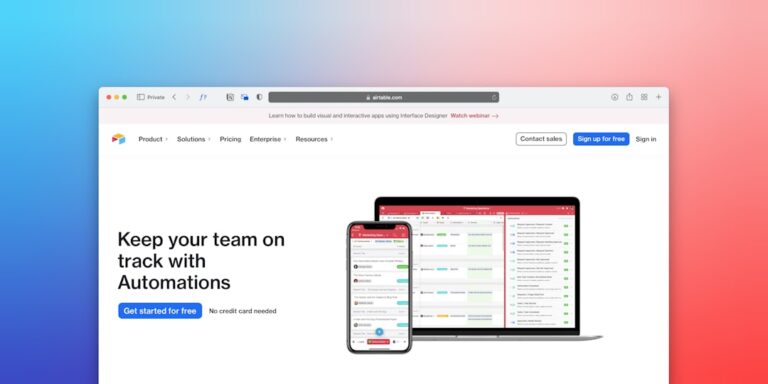
If you publish a blog post or record a video, that content shouldn’t live in just one place. Automation can push it to your email list, social channels, or content calendar without you copying and pasting across platforms. Connect your RSS feed to Zapier, and every new post automatically drafts a social update, sends a Slack notification to your team, or adds a row to your Airtable content tracker.
The Best No-Code Automation Tools for Small Business
| Tool | Best For | Free Plan? | Paid Plans From | Coding Required? |
|---|---|---|---|---|
| Zapier | Connecting apps, beginner workflows | Yes (100 tasks/mo) | $19.99/month | Never |
| Make | Complex multi-step logic, power users | Yes (1,000 ops/mo) | $9/month | Never |
| Notion | Client portals, project tracking, wikis | Yes (generous) | $12/month | Never |
| ClickUp | Task and project management automation | Yes (unlimited tasks) | $7/user/month | Never |
| Airtable | Client databases, content trackers | Yes (1,200 records) | $20/user/month | Never |
| Monday.com | Team workflows, visual project boards | No (14-day trial) | $9/user/month | Never |
| Calendly | Scheduling, booking automation | Yes (1 event type) | $10/month | Never |
Building Your First Automation in 4 Steps
If you’ve never built an automation before, here’s the fastest path from zero to your first working workflow — using Zapier as the starting point:
- Sign up for a free Zapier account and connect the two apps involved in your chosen task (e.g., Typeform and ClickUp)
- Click “Create Zap” and search for a pre-built template matching your use case — Zapier has thousands and most common workflows already exist
- Map your fields — tell Zapier which piece of data from the trigger (e.g., the “Name” field from your form) should populate which field in the action (e.g., the “Task Title” in ClickUp)
- Test it — Zapier walks you through a test run using real data so you can verify the output before turning the Zap on
The whole process takes 15–30 minutes for a single-step automation. Once it’s running, check the task history once a week for the first month to make sure it’s behaving as expected — then forget about it.
What to Automate Next: The Second-Level Opportunities
Once your core five workflows are running, the next tier of automation opportunities includes:
- Internal reporting — weekly metrics pulled from your tools and emailed to you automatically every Monday morning
- Team notifications — Slack alerts when a new project starts, a task is completed, or a payment is received
- Review and testimonial requests — triggered automatically 7 days after a project closes
- Recurring task generation — monthly or weekly task templates that appear in ClickUp or Monday.com without manual creation
- Data backup — automatic exports of key business data to Google Sheets or Airtable on a weekly schedule
- You don’t need to code to automate your business — Zapier and Make handle the vast majority of small business workflows with visual, no-code interfaces.
- Start with one high-frequency, low-judgment task: lead capture, appointment scheduling, or client onboarding are the highest-ROI starting points for most service businesses.
- Automate the ideal version of a process, not the broken version — map and fix your workflow manually before building automation on top of it.
- Free plans on Zapier, Make, Notion, ClickUp, Airtable, and Calendly are enough to build a meaningful automation stack before spending a dollar.
- Name your automations consistently, test them with real data before going live, and review task history weekly for the first month to confirm they’re running cleanly.
Frequently Asked Questions
Do I really need to know how to code to automate my business?
No — not even close. Zapier, Make, and the built-in automation features inside tools like ClickUp, Notion, and Airtable are all designed for non-technical users. If you can use a spreadsheet and follow a step-by-step wizard, you have everything you need. The no-code automation category has matured to the point where the tools are genuinely easier to use than most business software you already work with daily.
How much does it cost to automate a small business?
You can build a functional automation stack for free using the free tiers of Zapier (100 tasks/month), Make (1,000 operations/month), Notion, ClickUp, Airtable, and Calendly. For a growing business handling 3–5 new clients per month, a realistic paid stack — Zapier Starter ($19.99/month) plus Calendly Standard ($10/month) — runs about $30/month. That typically pays for itself within the first week of reclaimed time.
What’s the difference between Zapier and Make?
Zapier is faster to set up and better for straightforward, linear workflows (“when X happens, do Y”). Make handles more complex logic — branching paths, error handling, loops, and conditional routing — but requires more time to learn. Start with Zapier for your first automations and graduate to Make when you need workflows that require “if this then that, but only when Z is true” logic.
How do I know if a task is worth automating?
A useful rule of thumb: if a task takes more than 5 minutes and you do it more than once a week, it’s worth investigating automation. Calculate the annual time cost: a 10-minute task done daily is over 60 hours per year. Even if automation takes 2 hours to set up, the payback period is measured in days. Focus first on tasks that are high-frequency, low-judgment, and involve moving data between apps — these are almost always automatable and deliver immediate, measurable time savings.
What if my apps aren’t supported by Zapier?
Zapier supports over 6,000 apps, so most modern business tools are covered. If yours isn’t, check Make — its app library is smaller but covers different tools. If neither has a native integration, look for a webhook option in your app’s settings. Most modern SaaS tools support webhooks even without a dedicated Zapier integration, which lets you trigger automations from virtually any event. When in doubt, check the app’s documentation for “API” or “webhook” before assuming automation isn’t possible.