Best No-Code Project Trackers for Solopreneurs 2026
Disclosure: We may earn a commission when you purchase through links on this site, at no extra cost to you. How we make money.
Most project management tools are built for teams. They assume you have a Scrum master, a dedicated ops person, and enough runway to sit through a two-hour onboarding call. You don’t. You’re running the entire business from a single browser tab, and the last thing you need is a PM tool that creates more overhead than it saves.
The good news: no-code project trackers have matured enough in 2026 that you can get genuinely powerful systems without writing a single line of code — and without paying for seats you’ll never use. This guide cuts through the noise and gives you an honest comparison of the three tools solopreneurs actually choose: Notion, ClickUp, and Airtable.
Why Most PM Tools Fail Solopreneurs
The problem isn’t features — it’s design philosophy. Enterprise tools like Jira or Asana are architected for handoffs, approvals, and team visibility. Every workflow assumes multiple people touching the same task. When you’re a team of one, all that structure becomes friction.
What solopreneurs actually need from a project tracker:
- Fast capture: You need to add a task in under 10 seconds without navigating menus
- Flexible views: Switch between list, board, and calendar without rebuilding your system
- Automation-ready: Connect to the tools you already use — email, forms, invoicing — without a developer
- Low cognitive overhead: The system should reduce mental load, not become its own job
- Scalable pricing: A solo tier that won’t punish you for growing
With that lens, here’s how the top three contenders compare.
The No-Code Project Tracker Comparison
| Tool | Best For | Free Plan | Solo Paid Tier | Native Automations | Zapier/Make Support |
|---|---|---|---|---|---|
| Notion | Flexible all-in-one workspace | Yes (unlimited blocks) | $12/mo | Basic (Notion AI add-on) | Yes |
| ClickUp | Structured task + time tracking | Yes (100MB storage) | $7/mo (Unlimited) | Strong (100/mo free, unlimited paid) | Yes |
| Airtable | Database-driven client/project work | Yes (1,200 records/base) | $20/mo (Team) | Strong (automations + scripting) | Yes |
| Monday.com | Visual workflows, team handoffs | No (2-seat minimum) | $9/seat/mo (min 3 seats) | Yes | Yes |
Notion: The Flexible All-In-One
Notion works best when your projects aren’t purely task lists — when they overlap with client notes, SOPs, content drafts, and your own thinking. It’s a document-first tool that added database views, not a task manager that added documents. That distinction matters.
What solopreneurs love about Notion
- Linked databases: One project can connect to a client record, a deliverable tracker, and a meeting notes page simultaneously
- Views on demand: The same database shows as a Kanban board, a calendar, a table, or a filtered list — your choice, no rebuilding
- Templates: Notion’s template library has solid solopreneur setups you can install in two clicks and customize from there
- Free tier is actually usable: Unlimited blocks for one user means you can run a real system before paying anything
Where Notion falls short
Notion is not a task manager in the traditional sense. It lacks built-in time tracking, recurring task automation is limited unless you pay for Notion AI, and if your brain works better in a structured inbox-style list than a flexible canvas, you’ll spend more time organizing than working.
If you plan to use Notion as more than a project tracker — think client CRM, knowledge base, and proposal workspace — check out our guide on how to use Notion as a CRM for freelancers to get the full picture of what’s possible.
ClickUp: The Structured Powerhouse
ClickUp is what happens when you take every feature request from every project management forum and build them all into one tool. That sounds like a problem — and it can be if you try to use everything at once — but for solopreneurs who work in a structured, task-driven way, ClickUp’s free and Unlimited tiers are genuinely hard to beat on value.
What solopreneurs love about ClickUp
- Built-in time tracking: No add-on needed; track time directly against tasks for accurate client billing
- Native automations on free plan: 100 automated actions per month on the free tier — enough to run recurring task creation, status updates, and deadline alerts without Zapier
- Goals and targets: Set revenue or delivery goals and tie specific tasks directly to them
- ClickUp AI: Generate task summaries, pull weekly standup reports, and draft task descriptions without leaving the tool
Where ClickUp falls short
The feature density that makes ClickUp powerful is also its biggest risk for solopreneurs. It’s easy to spend an afternoon customizing instead of working. The setup overhead is real — you’ll want to spend time with a minimal setup before going deep on custom fields and views. Once you have a system, though, it’s sticky.
If you’re already using ClickUp or planning to, our deep dive on the best ClickUp automations for freelancers shows you exactly which automation recipes save the most time for a solo workflow.
Airtable: The Database-First Tracker
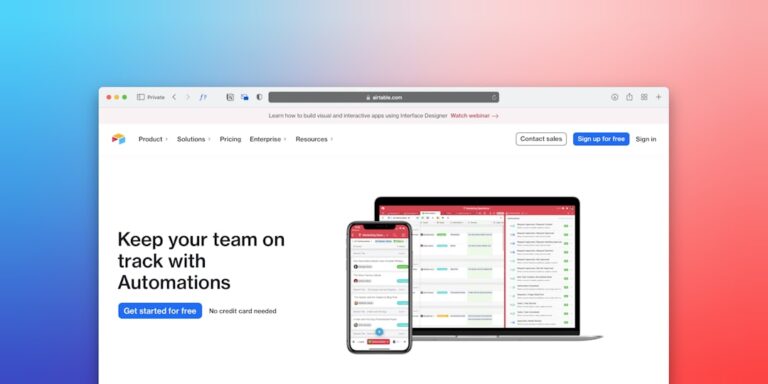
Airtable is the right tool when your project work is fundamentally about tracking records — clients, deliverables, assets, invoices — and you want to build custom views and automations on top of a structured dataset. It’s a spreadsheet that acts like a relational database, and that’s a genuinely different mental model than task management.
What solopreneurs love about Airtable
- Relational linking: Link a project to a client, a deliverable to a project, and an invoice to a deliverable — then filter any view by any of those relationships
- Interface Designer: Build a lightweight client portal or internal dashboard on top of your base without code
- Automations with scripts: Beyond trigger-action flows, Airtable supports JavaScript scripting for custom automation logic
- Forms: Collect intake data from clients and have it land directly in your project tracker as a new record
Where Airtable falls short
The free plan’s 1,200 record limit per base fills up faster than you’d expect if you’re tracking projects with multiple linked deliverables. And at $20/month for the Team tier, Airtable is the most expensive solo option here. It earns that price if you’re doing data-heavy work — but if you just need a task list with some views, it’s overkill.
For a full breakdown of what Airtable can automate once it’s your system of record, the best Airtable automations for small business guide covers the highest-leverage workflows.
How to Layer Automation On Top of Any Tracker
Whichever tool you choose, the real leverage comes from connecting it to the rest of your stack. A no-code project tracker is only half the system — the other half is the automations that keep it updated without manual effort.
The two go-to tools for this are Zapier and Make (formerly Integromat).
- Zapier is simpler to set up and has the broadest app library. If you need a new project record created every time a form is submitted, or a task created when a new invoice goes out, Zapier handles it with a 10-minute setup.
- Make is more powerful for multi-step flows — things like: client fills form → create project in ClickUp → send welcome email → schedule kickoff via Calendly → add to billing tracker in Airtable. One trigger, five actions, zero manual steps.
The combination of a clean no-code tracker and a well-built automation layer is what separates solopreneurs who feel in control from those who feel buried. If you’re new to this, our roundup of the best Zapier automations for solopreneurs gives you a step-by-step starting point.
Which Tool Should You Actually Pick?
Here’s the decision framework without the noise:
- Pick Notion if you want one tool for projects, notes, client info, and SOPs. You think in documents and need flexibility over structure.
- Pick ClickUp if you want a dedicated task manager with time tracking, recurring tasks, and built-in automations — especially if you’re billing hourly or need to track work against goals.
- Pick Airtable if your work is data-driven — managing many clients, deliverables, or assets — and you want to build custom views and automated workflows on top of a structured database.
- Skip Monday.com for now unless you’re already hiring. The 3-seat minimum makes it 3x more expensive than it needs to be for a solo operator.
- Notion, ClickUp, and Airtable are the three strongest no-code project trackers for solopreneurs in 2026 — each suits a different working style
- Notion wins for flexibility and all-in-one workspace use; ClickUp wins for structured task management and built-in automations; Airtable wins for database-driven, client-heavy workflows
- Monday.com’s 3-seat minimum makes it impractical for solo operators — better alternatives exist at lower cost
- Layering Zapier or Make on top of your chosen tracker eliminates the manual upkeep that kills most solopreneur systems
- Start simple: one tracker, one automation, running reliably — then expand from there
Frequently Asked Questions
What is the best free no-code project tracker for solopreneurs?
Notion’s free plan is the most generous for a single user — unlimited blocks and unlimited pages mean you can build a full project management system without paying anything. ClickUp’s free tier is also strong, especially with its 100 native automations per month. Airtable’s free plan is more limited at 1,200 records per base, which fills up quickly on active projects.
Do I need to pay for Zapier to automate my project tracker?
No. Zapier’s free plan supports up to 100 tasks per month across two-step Zaps, which is enough to run basic automations like “create task when form is submitted.” For multi-step automations or higher volumes, the Starter plan at $19.99/month is usually sufficient for a solo operator. Make’s free plan allows 1,000 operations per month, which goes further for complex flows.
Is Airtable really a project tracker or just a fancy spreadsheet?
Both, honestly — and that’s the point. Airtable’s relational structure lets you connect records across tables in ways a spreadsheet can’t, and its view options (Kanban, calendar, gallery, grid) let you look at the same data in ways that match how you work. For solopreneurs whose projects involve lots of linked data — clients, deliverables, assets, invoices — it works better than a pure task manager.
Can I use ClickUp for client-facing project tracking?
Yes. ClickUp supports guest access on paid plans, so you can give clients a read-only or limited view into relevant tasks without paying for a full seat. It’s not as polished as a purpose-built client portal, but it works well for project updates and approval tracking. If you want something more refined, pairing ClickUp with a dedicated client portal is worth the extra step.
What’s the fastest way to get started with a no-code project tracker?
Install a template before you build anything custom. All three tools — Notion, ClickUp, and Airtable — have template libraries with solopreneur and freelancer setups that are ready to use in under five minutes. Start with a template, use it for one real project without customizing, and only modify what actually feels broken. Most solopreneurs over-engineer their setup before they’ve done a single project in the tool.
Related Reading
- Top AI Productivity Tools for Solopreneurs in 2026 via BizRunBook
- Best CRM for Freelancers & Solopreneurs 2026 via SaaSSleuth